Skip to content
Key Elements of Commercial Electrical Panels
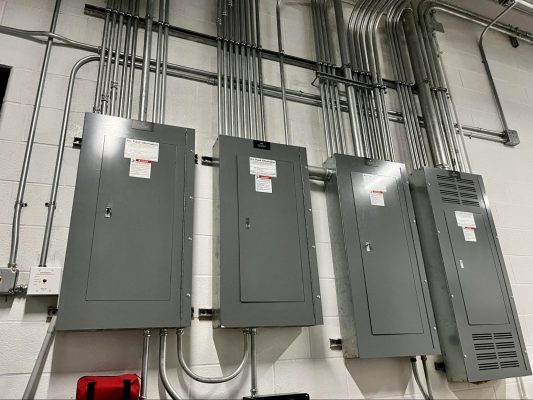
Commercial electrical panels are far more than just a collection of wires and switches. While they can look similar to residential panels, they’re usually much more complex and can handle greater loads.
For panels controlling power to larger premises, you may be looking at hundreds of individual circuits and breakers. As such, it’s important to not only understand how your panel works but also how to comply with safety regulations. To this end, we’ll cover:
- An overview of commercial electric panels
- Essential commercial electric panel components
- Safety features and compliance
- Installation and maintenance best practices
- Future commercial electric panel trends
After reading this blog, you’ll have all the knowledge you need to keep your business energized.
Need Expert Commercial Electrical Services? Contact Elliot Services Today!
Discover the difference 75 years of experience makes by scheduling commercial electrical services through Elliot Services. As your full-service electrical contractor, we can restore power to offices, restaurants, warehouses, and more.
Overview of Commercial Electric Panels
Commercial electrical panels control the distribution of electricity throughout nonresidential buildings. Unlike residential panels, which typically use single-stage electricity, commercial panels usually leverage three-stage power for greater versatility. This is necessary for powering electricity-hungry commercial appliances.
However, there are still many similarities between commercial and residential panels. Both feature a series of breakers, allowing you to cut power to specific appliances or circuits within the building. Commercial panels for hotels and other large businesses could easily contain more than 100 of these.
While most homes only have a main panel, businesses often also have several sub panels. These sub panels extend power to specific parts of the building, simplifying fault-finding and maintenance.
Essential Commercial Electric Panel Components
Commercial electrical panels adapt to the needs of each business. However, you’ll generally find the same types of components in each — albeit in different configurations. These components include:
- Main breaker: Cuts power to the entire premises
- Circuit breakers: Cut the power supply of specific circuits
- Bus bars: Carry electricity from the main power supply to individual circuits
- Neutral bars: Balance the electrical load by providing a return path to complete circuits
- Ground bars: Redirect electrical current to the earth for safety
- Surge protectors: Protect sensitive equipment from power surges
- Electrical circuit interrupters: Stop electricity flow in response to arcs or fires
- Meters: Monitor and report electricity use
All of these components are contained safely within a metal cabinet, which grounds the electrical panel and protects it from wear and tear.
Safety Features and Compliance
Safety is one of the most important things to consider when you look for an electrician. All work must comply with the National Electrical Code (NEC), which is updated every three years. Recent changes have included new requirements for surge protection devices in the service entrances of commercial buildings and enhanced GFCI protection requirements for areas near sinks.
Your panel itself contains a range of safety features based on the NEC regulations. The most important include:
- A main circuit breaker to cut off all power in emergencies
- Grounding to redirect stray electricity to the earth
- Ground fault circuit interrupters to reduce electrocution risk
- Arc fault circuit interrupters to reduce fire risks
- Surge protection devices to protect equipment from voltage spikes
Installation and Maintenance Best Practices
It’s important to have a professional install and maintain your panel following both manufacturer and industry guidelines. These guidelines include best practices such as:
- Maintaining appropriate clearance and spacing
- Using suitable mounting
- Installing grounding
- Using wiring that matches the ampacity requirements
- Labeling all circuits appropriately
To maintain safety, a quarterly and more extensive annual inspection are necessary. An electrician will also occasionally need to replace circuit breakers.
For optimal panel performance and longevity, you’ll need to perform thermal scanning, insulation testing, and power quality analysis each year. Only qualified electricians should handle these services.
Future Commercial Electric Panel Trends
Modern electrical panels can have several innovative features, including:
- Smart technology: Provides remote access to aid monitoring and control of your panel
- IoT integration: Enables your panel to connect with sensors and monitoring devices to improve safety and efficiency
- Energy monitoring systems: Shows electricity usage of each circuit to reduce energy expenditure
If you have an older panel, consider upgrading it today for improved performance and reduced electricity bills.
Upgrade Your Commercial Electrical System Today!
Get the job done to your exact specifications. Our licensed and insured experts handle all commercial electrical services in Kentucky. Contact us 24/7 for your electrical needs.